www.policeoracle.com News Feed

Showing posts with label Home Office. Show all posts

Saturday, 24 October 2009

THE TRUTH ABOUT CRIME & POLICING IN THE UK


Click above image to view full size

The Crime Analysis Team at Nice 1 are collating articles that will be published on these pages over the forthcoming weeks.

The articles will detail many of the "home truths" about crime recording and reporting, and the bureacratic and procedural obtsructions to officers providing the public with a better service. The articles will show that front line officers are frustrated at ridiculously excessive paperwork and processes that inhibit their ability to be truly effective.

Manipulated statistics and detection policies combined with excessive influence from politically correct committees and strategy teams, have turned the average officer into a box ticking, form filling adminstrator, who is in constant and non-sensical fear of being tripped up over administrative and procedural errors.

The vast majority of UK police officers are conscientious people who want to provide the very best service they can for the general public. These pages will show how, over many years, a web of deceit has been built around the real conditions faced by these officers in their attempt to perform their duty.

Grass roots police officers are indoctrinated into protecting themselves against nuwarranted attack from both their senior management teams (SMT's) and the very system they are forced to implement. As a consequence, you and I, the average UK citizen, are being deprived of the protection and response our millions in taxes is paying for.

Who are the culprits? Certainly not in the main, the bobby on the street, (the few that remain). Some (not all) senior officers, Home Office officials and politicians have combined down the years to create the flaws and inadequacies that exist within the service today, for their own purposes of political, career and financial advancement. The rot unfortunately, is not confined to the police service. The UK criminal justice system is severely flawed in many areas.

All is not as rosy as presented in Government and judicial headlines. It is not in their interest to reveal the truth of their systematic failures to the public, particularly not in the twelve months leading up to a general election.

Through these pages, we will present the information as we discover it for you to make up your own mind. We will, where appropriate lobby officials, raise questions, conduct polls, national surveys and petitions.

"Res Ipsa Loquitur" is latin for"let the facts speak for themselves".  We will present the information that will speak for itself.

A journey of a thousand miles begins with the first steps. The first steps that will be taken from this site will aim to bring this information to the forefront of public attention. We are not so unrealistic as to believe that we alone can bring about dramatic political and procedural change. Our aim is to encourage informed public debate about these subjects which affect the wellbeing of our society. Complete transparency for subjects that are within the public interest that do not conflict with matters of state and national security is a worthwhile goal.

Bookmark these pages and this site to keep informed of the progress. If you wish to contribute, we will understand that you may consider the content contraversial and that you may wish to remain anonymous with your submissions, through this or other sites we are monitoring.

The Crime Analysis Team
Nice 1 Limited Read more! Read more: http://www.blogdoctor.me/2007/02/expandable-post-summaries.html#ixzz0PTplKsFN

OFFICER SPEAKS OUT ABOUT LOW POLICE MORALE


LOW morale, not enough officers and a failing justice system are among the sentiments of rank and file police, a serving officer said today.The experienced officer did not want to be named, but spoke out amid a backdrop of crushing financial pressure from the government for the constabulary to slash millions of pounds from its budget. 

The modern police service faces many more challenges to its morale than ever before and many of the matters talked of here echo the sentiment of other articles from these pages. If the escalating problem of low police morale is the effect, what are the causes? 

Behind the scenes at this site, we are compiling hundreds of examples of officers voicing the same concerns about the decline of the service they love. The problem is not confined to a few disillusioned officers in small pockets of the country. This is a growing problem across all police forces in the UK, from an ever increasing number of rank and file frontline troops.

The balanced observations of one front line officer sum it up well. 

A POLICE OFFICERS VIEW FROM THE STREET


“I still love the job as much as I did when I first joined, but things have changed and not necessarily for the better. We see many times in the course of our careers all that is wrong with society and how inhuman people can be. Often a smile or joke can be a release valve. It seems more and more that we are not allowed an opinion or a sense of humour.

One thing that I have noticed more than anything is morale. I have never seen it so low. I talk to officers with five to six years service counting down the time they have left and that should not be.

My opinion for it being so low is down to a number of things; staff shortages, excessive workloads, a feeling of being let down by a seemingly uncaring senior hierarchy, the inability of the service in general to stand up for itself, and being let down by the judicial system.

I can say hand on heart that the vast majority of officers I have worked with over many years have been professional, caring, keen, and take great delight in locking up the bad guys.

On staff shortages, if you read the headlines from certain quarters they say we have no staff shortage problems. If the general public really knew that almost on a weekly basis and in some case daily, major towns have no officers to deploy to incidents as they are tied up on jobs or stuck in the custody areas.

It is not uncommon for officers to be drafted in from other areas leaving them short of cover, with specialist departments being used to backfill. Custody is regularly filled so that detained persons are taken to other stations. If this is the case then two officers are sent for escort and booking in.

Then the amount of time the booking in process takes, and then if that person is deemed as at risk he/she is put under constant supervision with a police officer. That means yet another officer down. You don't have to be brilliant at maths to see what the consequences are especially when I have known up to three constants on the go at the same time.

Officers who take crime reports are then allocated them to investigate. Obviously the more serious and involved are taken up by CID. As you can imagine an officer is not just given a couple to sort out but the list can be quite extensive.

The problem is that the list will continue to grow as more and more are allocated to that officer. With all the best will and dedication in the world some are not going to be investigated perhaps as fully as they could be.

This is not because the officer does not care. With time restraints and supervisory pressure, workloads must be trimmed. And I think you can guess the consequences.

The fact that a lot of offenders do not go to court is not down to the individual investigating officer or the service. It is down to the government department charged with prosecuting of suspects at court. They too have pressure to increase their conviction rates, so if they are not satisfied that there is a more than good possibility of a conviction they drop it straight away.

This is despite all the paperwork submitted, numerous interviews, and sometimes compelling evidence in the officers' eyes - and, most important of all, the expectations of the victim.

It does seem to be that before long they will only take on the guilty pleas.

Do I feel that we at times let the victim down? Yes. But we are not entirely to blame, the system is. I believe the system is squarely on the side of the offender rather than the victim. The younger and persistent offenders I come into contact with have no fear of the system or its punishments.

They look on young offenders' institutions as a holiday camp where they get free food, free games, free gym membership and are even allowed to keep together with their friends. They do what ever they like, when they like.

As police officers we are paid a good wage, and I for one have enjoyed every minute of it. I love my job and the satisfaction of getting a good result for the people who we serve. I feel the senior hierarchy needs to back us more and listen, not just preach. Yes, like all organisations or firms money is tight and cuts and financial savings have to be made, but not at the expense of the officers on the beat who are the backbone of the service and the ones getting the flak day after day on the streets.

We are the ones that have to face the job and all it entails face on and not from the comfort of a desk.”

Source : http://www.eveningstar.co.uk/

To read the full article, comments from his Chief Constable and Crown Prosecution Service click here.

COMMENT

Critical areas of police service policy and procedure is not only affecting officers morale. Many of the problems highlighted here are having a severly detrimental effect on public confidence in the police as a whole. Regrettably, the front line bobby is the thin blue line where the public aim their dissatisfaction. The target should really be the politicians and senior officers who set the policy these officers have to work with.

The general public want to see a more visible police presence, improved response times and common sense policing. Despite protestations from the Government to the contrary, there remains an excessive "performance culture" within the job. Combined with a lack of discretionary policing this has resulted in a service that is more consumed with political correctness and meeting statistical targets than the 'back to basics policing' the public and front line officers would like to see.

A disproportionate amount of time and resource is wasted on issues that affect a minority of the public. Meanwhile, the Government and senior officers perpetuate the the 'con' about declining crime figures and rising public confidence. The general public are not stupid. They are not taken in by statistics that are manipulated for the media or surveys that are not representative of the real public view.

The time for transparency is now. Clear the decks. Accept that the service has become swamped with bureaucracy and the quality of our society needs fixing fast if the country is not to slip into irreversible moral decline.

This will not happen within the time left with this Government. It seem likely that another party will be in power before any significant change will be seen. Will they be any different? For as long as politicians keep using crime and policing as a convenient political football to grow their overstaffed and excessive empires, then the answer is no.

A radical, honest and transparent approach is needed if public and police confidence is to be restored.

Acceptance that a system is not working is a first step. Forget blame, we don't care what or who caused it, we just want it fixed. Learn the lessons that are staring us in the face. Dismiss the performance culture policing, listen, HEAR and ACT upon what the front line coppers are telling us is inherently wrong with the service. Make every effort to eliminate committees and projects that detract from basics. Reverse the trend of spending 90% of the time and resource planning how you will improve things and 10% of  the time actually doing it. Stop giving us statistics and headlines we stopped trusting long ago. Give the police their dicretional common sense freedom that will enable them to do the job they joined for.

Are there any politicians and senior officers courageous enough to take the action needed? 


Crime Analysis Team
Nice 1 Limited Read more! Read more: http://www.blogdoctor.me/2007/02/expandable-post-summaries.html#ixzz0PTplKsFN

ARE YOU READY FOR THE TRUTH ABOUT POLICING IN THE UK?


One of the better police blogs is http://200weeks.police999.com/ which burst into life on September 9th 2005. The site was created by a rEgular police officer who has dedicated his life to the force and area that he serves.

In his own words, the site author has spent his entire life "in the trenches" as a front line officer. In February 2009, the author hung up his boots and truncheon, and after 30 years service, became a civilian in his police force control room, a vantage point from where he is able to continue his insightful reports on policing as it really is in the UK today.

A prolific and intelligent writer, "200" posts regular articles that provide an honest and informed view of the challenges that face police officers in their attempts to deliver a fair system of justice, despite an ever increasing burden of bureacuracy and idiotic procedures.

The articles reprinted below are two fine examples from "200" of real world of policing in Britain in 2009.

NOT IMPORTANT ENOUGH

The dreadful case of Fiona Pilkington whose life was blighted by anti social youths on her estate to such an extent that she took her own child’s life & committed suicide by setting fire to her car as they sat in it, will have some far-reaching repurcussions. The surprise is that, in the two years since this tragic event happened, there has been just about zero change in the way police deal with anti-social behaviour.


I spend every late shift in every town I control not sending police officers to anti social youths. This is despite the fact that I know what an effect it can have on people’s lives let alone their peace. I’m almost ashamed to say but I have anti social behaviour in my street & I never report it to the police, the reason purely & simply is, I know there is little chance of the police arriving before the youths have moved on. If it’s gotten too bad I have gone out there myself & given some ‘advice’, though I don’t like doing this in my own street. (I tend to climb over my back fence & appear from somewhere not near my house so they don’t know where I live).

The apalling crux of the matter is one of mathematics. We have X-amount of officers & we get Y-amount of jobs which take Z-amount of time. When Y x Z > X we cannot possibly get to all the jobs on time, if at all. We either have to make people wait, in some cases days, or we just don’t go.

The problem with antisocial behaviour is that it doesn’t fit in with any targets & we don’t get to tick any boxes. When Jay sends a text message to his ex-girlfriend Leah saying she’s a slag, that’s threats to violence or damage, malicious communications or a domestic, all of which are recordable & may result in a detected crime. When Mrs Miggins is fed up to the back teeth with a bunch of teenage yobs who spend every night shouting & swearing outside her bedroom & pissing up against her fence, that’s just a bit of ASB. Guess which one gets an officer sent to it whether they want one or not & which one gets closed off 2 hours after the youths have gone elsewhere with a ‘no officer available’ closing.

Mrs Pilkington did not have the protection afforded to certain groups within society. Had she been black or Asian, Jewish or gay, she would have had an officer every single occasion she phoned. There are teams within each police force whose sole job it is to look at ‘hate’ crimes against minority groups. I well remember a case of some kids throwing snowballs at a Jewish shop, on a day when the kids were throwing snowballs at everyone & anyone & we didn’t have the resources to deal with all the accidents & crime let alone kids chucking snowballs. Most of the snowball jobs just got closed off because there was absolutely no chance of us sending anyone; we had more important & immediate things to do. The Jewish shop had to remain open because the racism word had been mentioned. Within an hour the Inspector in charge of the diversity unit was on the phone to the control room inspector demanding to know why this racist incident hadn’t been assigned within the 1 hour requirement of force policy.

Nobody phoned up from any police unit who sit on their arses looking at logs in some office somewhere at HQ on behalf of all the other people being taunted by kids with snow. The fact that Mrs Pilkington had a disabled daughter, much of which taunting was aimed at, doesn’t seem to have cut any ice with the local constabulary.

I’ve blogged before about the unfairness of diversity policy & have argued that everyone should be treated on their own merits only. It completely baffles me that, for instance, a 6′6 Afro-Caribbean nightclub bouncer with years in the nighttime entertainment trade, who gets called a rude name is entitled to a better service than a vulnerable teenage girl who may be, unknowingly to us, considering suicide because of some bullying. How can a rule written on a policy somewhere at police HQ possibly differentiate between the effect on these two people & class one as somehow more deserving of a higher response than the other. Where is the leeway to attend based on the individual potential effect on the victim?

Just occasionally, someone will come up with a local operation to target antisocial behaviour. Extra resources will be called in & they will be tasked for ASB jobs alone, unavailable for RTCs, assaults or domestics. This is a clear acceptance of the importance of tackling such behaviour, but if it is important, why isn’t important all the time & on every estate.

Antisocial behaviour is the key to so many more problems in society. Someone who grows up not having consequences for their behaviour will learn that they are entitled to do what they want, when they want, to whom they want. They will grow up with a me, me, me attitude & will spend the rest of their lives demanding everything they can get. A child who grows up to respect other peoples needs & rights will end up as net givers to society.

When I was on the street I actually enjoyed helping to make other people’s lives a little better. One of the reasons I wanted to join the police was to help people who couldn’t help themselves. I held that belief until the day I retired. I still believe it. I am unable to do it because I do not have the resources nor the will from those who run the show to sort the matter out.

After the story of Mrs Pilkington, I will be wondering if the next job I fail to send an officer to will end up with someone murdering their child & topping themselves. That’s simply not fair & I don’t have the power to address it properly.

Time will tell whether the fallout from Mrs Pilkington will make any difference.

AND SO IT GOES . . . .


Twenty years ago Mrs Pilkington would have had a much better service than she got in the years leading up to 2007. There were many thousands less police officers. In March this year there were 144,000 police officers. In March 1987 there were 120,000.

We have 24,000 more police officers yet those available for front line policing have been slashed dramatically. I don’t have access to any figures for the amount of officers available for day-to-day policing calls so I can only go by my own experience. In 1987 one division I worked in paraded 18 officers split between 4 police stations. This did not include 3 rural cars which covered the villages, 1 officer in every neighbourhood beat & a rural officers who shared all the villages between them. We put out 9 patrol cars in the division plus a walker in each of the town centres & the police stations were open 24 hours a day.

Now those same 4 towns have a maximum of 8 officers between them, we are lucky if they can put out 5 cars in the whole division, all of the police stations are closed longer than they are open.

Back in the day the village bobby lived on the patch & knew everyone & everything there was to be known. He probably looked after 2 or 3 villages. Every estate had a neighbourhood officer who lived on their patch, they often had a little police office attached to their house, they too knew everyone, they were a vast source of information. What they knew & what they did couldn’t be recorded in an exel spreadsheet yet their value to policing was enormous.

Then someone in a wendy house somewhere decided that the only way to measure the success of an organisation was to match its performance against a written down set of criteria & the way to do this was to count beans. Suddenly, the value of everything was measured in beans & rural/neighbourhood officers didn’t grow any beans on their patches. Add to that the fact that they lived in expensive police houses.

The theory went that if you did away with neighbourhood & rural officers not only could you pull them all back to the nick where they could produce a few beans, you could also save the expense of maintaining their houses, sell them off & plough lots of lovely lolly into all the new & dynamic projects which were about to hit the world of UK policing. We lost a generation of intelligence which we are only now getting back, amazingly enough, through local PCSOs, who will, within a few years, be just as valuable a tool to police intelligence as the old village bobby.

It made good political – read voting – sense to increase the number of bobbies, so every government promised more. More bobbies means more votes ‘cos we all want more bobbies on the streets, only they never made the streets. They all went into disparate little ‘remit’ teams. You know the teams, they are the ones you ask for help when you’re struggling to meet all the frontline priorities who turn round & say “sorry, mate, not my remit”.

So we had the burglary squad, set up to specifically target burglary beans, the robbery squad busy collecting robbery beans, sexual offences squad, paedophile squad, computer crime squad, diversity squad, more officers means more potential for naughty goings-on so the rubber heel squad was boosted. We had the serious crime units, the bloody serious crime units, organised crime, it goes on. Then there are the units who monitor the other units, who count the beans, who supervise those who count the beans, who make sure the right beans are being counted.

So every time an Inspector of Constabulary comes a-calling & says, “now look here Mr Chief Constable, your force is doing particularly low in detections of spanner-wielding credit-card thieves” we have to have a department whose soul aim is to reduce spanner-wielding credit card thefts.

The problem for those on the front line is that most of the calls we get don’t lead to all the remit-beans. Nobody measures the prevention of crime, nobody measures kids who piss up your garage & chuck eggs through your windows, nobody measures depressed people who threaten suicide but never go through with it. You don’t get a bean for sitting outside a row of shops stopping the kids from spitting at people with special needs.

And if they’re not measured, they’re not important.

If the next Inspector of Constabulary comes round & says “Now look here Mr Chief Constable, the behaviour of teenage yobs in this area is apalling, this chart shows a 150% increase in bad language in front of old ladies, get it sorted” you’ll have so many shiny-arses out of their offices that the problem could be sorted in a year.

It ain’t gonna happen, though.

COMMENT

The authors of this site have been contacted by senior politicians who are capable of introducing effective criminal justice reforms. They tell us that they are interested and paying regular attention to the content on these pages. Whilst the statistical analysis contained in the reports from these pages is our work, the majority of the real life experiences are inspired by or drawn from people at the coal face of British policing, such as the author of the 200 site, Inspector Gadget, PC Bloggs and others contained in the "Thin Blue Line" links opposite.

To the politicians, Home Office civil servants and senior officers that may read these pages, we would invite you to spend some time reading some of the enlightening articles contained on these and other front line policing sites. Be prepared to confront the real world head on through these pages. We invite you to step out of your environment for a while, so that you may empathise with the challenges and obstructions faced by the front line officer. The content is an often colourful, honest view of the framework within which our guys at the coal face of society perform their increasingly difficult duty.

Listening is not enough. Take what you hear to heart. Then take the effective action only you are empowered to take, to make the necessary reforms that may ultimately restore public confidence in the Criminal Justice System that should be the bedrock of a decent, peaceful society.

We know the challenge is a difficult one that will require all your reserves of courage and direct thought. We know it involves accepting openly and honestly that mistakes have been made. Only by applying this level of honesty and transparency in any reforms you consider are appropriate, will your efforts bear the fruit in transforming society.

Britain is broken. You have the power to fix it. Cut through the distractions and obstructions that have plagued modern policing. Let us hear less of the minority projects and more of firm and effective use of police resources. Show us evidence that our taxes are being well spent, that the ratio of frontline officers actually available for real policework, dramatically exceeds those tied up counting beans, creating flow charts and ivory tower projects to justify the perpetuation of departments crammed with wasted resources.

Spend our money wisely. Show us the real value we deserve to see. You will find you have a much greater degree of public support and confidence from the wider public than you may have imagined.

We hope to see evidence of your efforts very soon.

The Crime Analysis Team
Nice 1 Limited Read more! Read more: http://www.blogdoctor.me/2007/02/expandable-post-summaries.html#ixzz0PTplKsFN

Wednesday, 21 October 2009

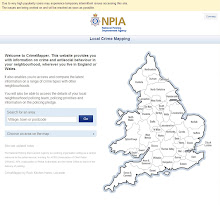
CRIME MAPPING - IS POLICE RECORDED CRIME A TRUE MEASURE?


Click on the map or the link in the sidebar


An interactive map offering detailed crime statistics on every street in England and Wales crashed hours after its launch yesterday.

Those attempting to visit the site, http://maps.police.uk/ were shown an automated message saying it was temporarily unavailable.

The teething problems surfaced as Home Office minister David Hanson officially unveiled the website during a visit to a regeneration project in south west London. He was joined by National Policing Improvement Agency (NPIA) deputy chief executive Steve Mortimore, whose colleagues drew up the map.


The website aims to offer members of the public unprecedented access to information about crimes taking place in their neighbourhood. The national map follows on the heels of regional versions created by the 43 forces across England and Wales.

Users should be able to access figures on levels of burglary, robbery, violence, vehicle crime and anti-social behaviour. They can also compare one area against another and compare figures against the same period the previous year to see if crime is getting better or worse. The website also offers messages from senior officers and links to local policing priorities and information about forthcoming crime-fighting events.

A Home Office spokesman said: "The high level of public interest in the new national crime map has put temporary pressure on the website. Urgent work is under way to resolve this and the website should be working again shortly."

The launch of the “Crime Mapping” facility, http://maps.police.uk/ unites the crime statistics of the 43 police forces of England & Wales under one software banner for the first time.

This is long overdue. Earlier in the week an article posted on http://thinblulineuk.blogspot.com/ complained that the Home Office were allowing 8 forces responsible for 40% of the population and 48% of crime to use their own software. Cynical perhaps, but we suspected that this was yet another Home Office strategy to prevent the general public from accessing the full picture of current recorded crime, and also continuing the “fudging” of figures.

After the shaky start when the facility kept freezing up, it started to work more efficiently this evening. We have attached a composite report of the 43 forces current recorded crime for Burglary, Car Crime, Robbery and All recorded crime. On completion, we are not one bit convinced that the police recording of crime is now an accurate reflection of crime in the UK.

A Few Observations

• The “All Crime” monthly average for the most recent three months is 357,365 incidents
• On that basis, the full year forecast will be 4,288,380 crimes
• In 2008 the recorded crime incident was 4,703,814 (-415,434)
• Will we be expected to believe a crime reduction of 13.4% ??
• This is more than a months full crime reporting for the nation!

Click on table below to see larger image


• In 2008 as in previous years, the BCS estimates of crime were over twice that of recorded crime
• Front line officers tell us that if anything, the volume of crime is increasing NOT decreasing
• Crimes are often misclassified… robbery downgraded to theft, car theft included in burglary when keys are stolen on egress
• How many crimes are not now reported as such, if the victim does not insist? (Citizen focus?)
• Has public confidence sunk so low that they have simply lost all faith in reporting?
• The BCS last year suggested that reporting had dropped as low as 33% for some offences, to 38% overall

To quote from the Home Office BCS : “For the crime types it covers, the BCS provides a better reflection of the true extent of household and personal crime than police recorded statistics because the survey includes crimes that are not reported to or recorded by the police. The primary purpose of the BCS is to provide national level analysis but some headline figures are available at regional and police force area level. The BCS is also a better indicator of long-term trends than police recorded crime because it is unaffected by changes in levels of reporting to the police or police recording practices”.

• This implies that the Government will place importance on police recorded crime only when it suits them. i.e. If recorded crime shows a decrease, with all the measures introduced to achieve that.
• The table below shows a steady decline in reporting of overall crime in the last 12 years, coincidentally the years of New Labour.
• Does this explain the “gap” of crimes that seem to have appeared in the reduction of reported crime?
• With so many new offences created, we are advised that it is simple to reallocate a reported offence to a lesser category.
• Section 5 Public Order Offences (crimeable) are now commonly demoted to drunk and disorderly (no crime report)
• Of those interviewed by BCS, 76% said they did not report because they felt the police would not/could not do anything
Click on table below to see larger image


• Is that what the Criminal Justice System has come to, that the public won’t report because they have lost heart?
• Could this be a major contributory factor to the decrease in recorded crime?
• Has the massive surge in bureaucracy resulted in the massive misreporting of crime?
• How timely that the Government have pushed through the alignment of 43 forces data for current crime
• Are they planning yet another media spin about how crime has been dramatically decreased thanks to their effort?
• The recorded crime shows reductions of 5% burglary, 18% car crime, 7% for robbery and overall crime
• The target, performance and senior officer bonus culture will continue to “fudge” until stopped.
• We are guessing that a Home Office release will be imminent.

We wish we could accompany all of this skepticism with a dose of solutions, but unfortunately, we cannot yet see an answer. Clearly, the crime recording system is flawed and unreliable as a measure of crime. Detections are similarly distorted it would seem. It will be a courageous team that arrives at an acceptable solution that will encourage confidence to return, in the face of a Government and senior management teams that will apply many more dirty tricks to keep their noses buried in that trough. The BCS is only based on a trawl of 46,000 members of the public which hardly seems representative.

We would advocate and support the proposal to make crime statistics properly independent. This would remove responsibility for compiling and publishing crime figures from the Home Office. The responsibility should be placed with the Office for National Statistics which is totally independent. The pre-release access that Ministers and political advisers get to crime statistics should be abolished – so the public would be the first to get an honest account of the facts. Any politician can talk about resuscitating public trust.

The party that demonstrates their intentions and follows it up with decisive transparent and honest action that is genuinely in the public interest, will have the best chance of achieving it.

Crime Analysis Team
Nice 1 Limited

Read more! Read more: http://www.blogdoctor.me/2007/02/expandable-post-summaries.html#ixzz0PTplKsFN

Wednesday, 14 October 2009

CONSERVATIVE PROMISE - IN A NUTSHELL


Following on from the rousing Conservative party conference in Manchester last week, here, in a nutshell, are a selection of observations, quotes and pledges from the speeches of David Cameron and Chris Grayling on the plans they have to reform the Criminal Justice System.


  • Criminals aren't caught because the police are stuck at desks doing paperwork.

  • Violent offenders, sex offenders and heroin dealers get off with cautions because it’s the least hassle.
  • Even if they go to prison, the Government releases them automatically after a fraction of their sentence to reoffend on the same streets as before.
  • People think our criminal justice system is broken.
  • Worrying too much about the criminals and not enough about the justice.
  • It makes me furious. It makes you furious. And law abiding, decent, people are asking - who’s looking after me?
  • That’s why need radical reform in every part of the system. The police. The CPS. The courts. Prisons. Probation. We need to sort it out, so there's no more excuses, no more buck-passing, no more nonsense. We need a criminal justice system that is focused on fighting crime and that is exactly what we plan to deliver.
  • No one thinks that the Government’s 24 hour drinking regime has led to the creation of a “continental café culture.
  • We’re not talking about stopping people enjoying a few drinks in the pub. But things have gone far too far. Our town centres on a Friday and Saturday night can be battle zones for our police. Local parks and local estates are blighted by gangs of young troublemakers…. fuelled by alcohol given to them by irresponsible adults.
  • I have talked to people up and down the country whose lives are being ruined by antisocial behaviour. It’s time we stood up for them.
  • We’ll start with the problem of fourteen year olds hanging around with bottles of super-strength beers or ciders. It’s much too easy for them to get very drunk quickly and cheaply.
  • We will increase the price of a four pack of super strength lager by £1.33. We will more than double tax on super strength cider. And our planned increase on alcopops will raise the price of a large bottle by £1.50. These tax changes will not hit responsible drinkers.
  • We’ll tear up this Government’s lax licensing regime. Right now virtually anyone can get a licence to sell alcohol. We even have all night takeaways selling more drink to people as they stagger home from the pub. We will change that.
  • We’ve also got to deal with those who commit the acts of antisocial behaviour and disorder as well. Right now they can offend again and again and just get away with it.
  • Our criminal justice system is sending all the wrong messages. We need real punishments for young troublemakers. Not to send them home with a rap over the knuckles. That’s why we are working on a range of instant punishments for antisocial behaviour.
  • Like grounding the offenders for up to a month. Or making them do community punishments, like cleaning up local parks. Real consequences for the trouble they’ve caused. But that’s for low level offences.
  • For the more serious incidents, things must be different. We were all shocked by the tragic case of Fiona Pilkington. But let’s be clear. What happened to her wasn’t antisocial behaviour. It was criminal.
  • Giving someone a caution or a fixed penalty notice means box ticked, case closed, another solved crime. But we know the system is being misused.
  • But when serious offenders, like people carrying knives, also get off with a caution, when they should be behind bars.
  • I think anyone who assaults a police officer should end up in court facing time behind bars.
  • It’s time for a new deal with our police. We’ll deal with the things that frustrate them. We’ll get rid of the mountains of bureaucracy that make it easier to cut corners. We’ll provide them with proper protection against violence. We’ll get rid of the target culture that makes it easier to issue a caution than to prosecute. And we’ll give them back more power to charge criminals themselves.
  • But in return we want real action against the troublemakers. And we want them to be more accountable to the communities they serve. The next Conservative Government will get rid of Britain’s caution culture. And will demand real moves to tackle antisocial behaviour. It’s time justice was really done on our streets.
  • We will tear down Labour's big government bureaucracy, ripping up its timewasting, money-draining, responsibility-sapping nonsense.
  • The police, the prosecution services, the prisons … is failing under the weight of big government targets and bureaucracy. The police aren't on the streets because they're busy complying with ten different inspection regimes.
  • The police say the CPS isn't charging people because they have to hit targets to reduce the number of unsuccessful trials.
  • And the prisons aren't rehabilitating offenders because they're focused on meeting thirty three different performance indicators.
  • This all needs to change. I'm not going to stand here and promise you a country where nothing bad ever happens. I do not underestimate how difficult it will be to deal with this problem of crime and disorder.
  • We cannot rebuild social responsibility from on high. But the least we can do the least we can do is pledge to all the people who are scared, who live their lives in fear and who can't protect themselves, that Chris Grayling, with Dominic Grieve, will reform the police, reform the courts, reform prisons.
  • I see a country where you're not so afraid to walk home alone, where you're safe in the knowledge that right and wrong is restored to law and order.
  • But if we pull together, come together, work together — we will get through this together.
  • And when we look back we will say not that the government made it happen … not that the minister made it happen … but the businesswoman made it happen … the police officer made it happen … the father made it happen …the teacher made it happen.

You made it happen.


Right now it seems that the Conservatives are closest to the real issues and have the desire to bring about the reforms that are essential if we are to enjoy a more peaceful society. The message we would send out to whichever party is elected at the next election is this. Show us that you have learned from the lessons, mistakes and errors of judgement of the past. Waste no time on party policital spin, we've had a belly full of it. Ditch the blame culture once you have cleared the decks. Show us the truth about the state of the Criminal Justice System as it stands now, then waste no time on blame, show us with your actions that you are healing the wounds inflicted on this country over recent years. Then you will have our blessing, support and confidence. 
 
One last thing. There will be sectors of society waiting for you to trip up. Show us your guts and determination to succeed for us all. Don't give them the ammunition to shoot you. There will be those who will accuse you too, of having your noses buried deeply in the trough. Be aware of that. Act with transparency and honesty so that we will not feel our trust is misplaced.   
 
The Crime Analysis Team
Nice 1 Limited


Read more! Read more: http://www.blogdoctor.me/2007/02/expandable-post-summaries.html#ixzz0PTplKsFN

Thursday, 24 September 2009

PHIL JAGIELKA HAS CAR STOLEN AT KNIFEPOINT


A Premiership footballer has been confronted by knife-wielding burglars in a terrifying raid on his home.

Injured Everton star Phil Jagielka, 27, was watching his team on TV when three men burst into the mansion in Knutsford, Cheshire.

The married star, a father-of-two, was threatened with a knife and forced to hand over jewellery and the keys to his Range Rover.

A spokeswoman for Cheshire Police said: "Three men gained entry to a house in Knutsford.

"The homeowner was threatened with a knife and forced to hand over jewellery and the keys to his Range Rover car.

"Fortunately nobody was hurt during the incident and the car was found abandoned a short distance away."

The robbery took place at around 8pm on Wednesday as Everton were playing Hull City in the Carling Cup.

Jagielka is the latest in a growing list of footballers whose homes have been targeted by raiders.

Last month the Blackburn Rovers midfielder Vince Grella was also held at knife-point when thieves smashed their way into his home in Wilmslow, also Cheshire.

Other players to have been targeted in the past include Liverpool captain Steven Gerrard and Tottenham striker Robbie Keane. Read more! Read more: http://www.blogdoctor.me/2007/02/expandable-post-summaries.html#ixzz0PTplKsFN

Sunday, 6 September 2009

CRIME STATISTICS HIDE THE TRUTH


Click on image to enlarge
BRITISH CRIME SURVEY OR RECORDED CRIME - WHICH IS RIGHT?
We have been looking at the crime statistics released by the Home Office.

Despite having trawled through the guidance notes that accompany the Government statistics, we are at a loss to account for the massive disparities that exist between the British Crime Survey and Police recorded crime.

The Home Office clearly place great importance on the British Crime Survey (BCS), as this quote from the Home Office website confirms :-

"The BCS includes crimes which are not reported to the police, so it is an important alternative to police records. The BCS is a particularly important survey because it can provide a more complete picture of crime than police recorded crime statistics alone. The BCS includes crimes which are not reported to, or recorded by, the police and is therefore unaffected by changes in recording practices. It can provide the best guide to long-term trends in crime".

The crime statistics that tend to hit the headlines are the ones that can most easily be manipulated.
As the above report shows, the tried and trusted BCS figures, reflect a crime rate double that reported to the police. The supporting document goes to great lengths to describe why so many offences are not reported to the police. To download a copy of the report click here

Reports from front line officers, of ridculous levels of bureacracy and procedure confirms what many of the public already suspect, that their effectiveness is severely impaired. This results in a lack of public confidence, not in the bobby on the beat, but in the system of policing in the UK.

The report shows the BCS comparable count and the actual recorded crime for key offences.
It suggests that violence is twice that reported and robbery 5 times the police figure.

5 YEARS ON - NO BETTER

Five years ago, a letter was sent to the London Evening Standard, by PC Norman Brennan, serving as Director of Victims Crime Trust. The letter is reproduced below :-

Crime statistics hide the truth

IT is rare that front-line police officers speak out, but I feel the public has the right to hear us.
When I joined the police service in 1978, there were only 13,150 recorded robberies in England and Wales. Most robberies were reported because of public confidence in the justice system.

Last year, this figure had risen to a massive 101,195 recorded robberies, and the British Crime Survey, the Government’s preferred method of measuring crime, which made your front-page last week (22 July) will show the true figure to be at least double or triple this number.

Murder is at its highest rate since the Second World War. The only reason it is not many times higher is because of the skill of our surgeons.

Although police chiefs are loath to admit it, there are parts of our cities that are, in effect, no-go areas. My colleagues joined the police service to protect and support the public, but they are prevented from doing so now because of huge amounts of political correctness and red tape. We are given so many targets we almost stand still.

Politicians can make statistics look as good or as bad as they want, but the police and the public live in the real world and know the truth. I am amazed even in the latest British Crime Survey, the

Government omitted crimes of murder, sex offences, fraud, crime against commercial premises and, more important, crimes against children under 16, who make up a significant proportion of victims of crime.

I believe the situation on law and order is so bad that, to borrow a medical term, it is on a life-support machine. In my personal and professional opinion, the criminal justice system is in crisis. It is not just criminals we should be putting in the dock, but the Government. Mr Blair, you can fool some of people some of the time, but not all of the people all of the time.

PC Norman Brennan, director, Victims of Crime Trust, Twickenham, Middlesex.

From Blair to Brown, five years later, little has changed, as the report above shows.

Crime is still significantly higher than the authorities would have us believe.

Front line police officers are still discouraged from speaking out about the lack of resources and being buried in paperork and bureaucratic "protect the backside" processes that prevent them performing more effectively.

Politicians still have too great an influence over policing in this country. Having two sources of crime statistics enables politicians to manipulate headline to read exactly how they want, with their own reasond for doing so.

As one officer put it "The police service is living and telling lies at the moment just like MP’s expenses. Someone is going to get caught out soon, but they just don’t get it do they!"
Enough said.

Crime Analysis Team
Nice 1 Limited Read more! Read more: http://www.blogdoctor.me/2007/02/expandable-post-summaries.html#ixzz0PTplKsFN

Saturday, 5 September 2009

FOCUS REPORT : POLICE RESOURCES


To see the latest analysis report from Nice 1 Ltd, visit the post at our sister site "The Thin Blue Line", by clicking here

The post looks in detail at the scant resources of UK police forces to deal with crime and policing.


The Crime Analysis Team
Nice 1 Ltd Read more! Read more: http://www.blogdoctor.me/2007/02/expandable-post-summaries.html#ixzz0PTplKsFN

Sunday, 9 August 2009

THE TOP 10 SAFEST & RISKIEST PLACES FOR CAR THEFT - CAR CRIME UK 2009

double click the map to see it larger then hit back button to return here


The team at Nice 1 Limited regularly produce car crime information for the UK motoring public and to assist the marketing efforts of our authorised Theft Protect agents.


For the first time in the UK, Nice 1 are delighted to produce the 2009 Car Crime figures by Post Code area. The information contained on the map above and tables below is extracted from the full Home Office statistics. Insurance companies and intermediaries frequently publish similar data, however, their data is only drawn from the sample of their own customers.


The information reprinted here is the most accurate and current information compiled from the car crime incidents recorded by the UK police forces. Full UK car crime data is available, both as incident counts per town or city, and as the detail below, on the basis of a count per 1000 head of population. The national average for car theft is around 7 per 1000. The map and tables below provide an indication as to the vulnerability to car theft offences in the safest and riskest places in the UK.

THE TOP 10 RISKIEST PLACES FOR CAR THEFT


THE TOP 10 SAFEST PLACES FOR CAR THEFT


Nice 1 Ltd collate car crime statistics from Home Office and police sources in order to provide the UK motoring public with the most accurate picture of car crime across the country and in specific areas. In addition to the offences per head of population, information is also gathered about the number of incidents recorded per town and city. Further details may be requested by e mail at the contact address at the foot of the page or by clicking the contact me button elsewhere on these pages.
Read more! Read more: http://www.blogdoctor.me/2007/02/expandable-post-summaries.html#ixzz0PTplKsFN

Saturday, 8 August 2009

UK Crime 2008/09 - At A Glance Part 2 Burglary

Click on the map to see larger view, then hit the back button to return to this page

DOMESTIC BURGLARY ON THE RISE !

IT MAY BE YOUR CAR THEY'RE AFTER

The crime analysis team at Nice 1 present a post code visual map of the burglaries reported to the police in 2008/09.

Post code areas shown in red experience a significantly higher than average incident rate of burglary. Areas shown in amber experience, at best, average levels. Areas in white experience average or below levels of burglary.

The 2008/09 the Home Office survey shows there were an estimated 744,000 domestic burglary incidents in England and Wales. The number of domestic burglaries with entry to the property and attempted burglaries for 2008/09 is estimated by the survey at 452,000 burglaries with entry and 292,000 attempted burglaries.

The number of police recorded domestic burglaries rose by one per cent to 284,445 offences.

The Home Office estimates that only 65 per cent of domestic burglaries were reported to the police and that burglaries with loss were most likely to be reported.

These figures support previous articles from the Nice 1 team, highlighting the disparity between the Home Office survey and the actual incidents reported to police. Assuming the Home Office survey figures are correct, whn factored into the recorded burglary numbers, the rise in burglary is significantly higher than the 1% reported.

CAR KEY BURGLARY

A Parliamentary answer given by former Home Secretary Jacqui Smith confirmed that over 15,700 cars disappeared when keys were stolen during a burglary and a further 2,900 drivers were robbed to obtain keys by, for example, mugging, pickpocketing or carjacking. The improvements in car security and the increased risk of capture when breaking into vehicles has led the UK car criminal to up the stakes and break into homes to steal vehicle keys. This trend is increasing around the UK and the Nice 1 team will provide regular updates from these pages.

To see a detailed report on the effect of Car Key Theft on the statistical reporting of car crime, click here or look for Car Key Theft in the crime analysis report links opposite.


Read more! Read more: http://www.blogdoctor.me/2007/02/expandable-post-summaries.html#ixzz0PTplKsFN

UK Crime 2008/09 - At A Glance - Part 1 Car Crime

Click the map for a larger view, then hit the back button to return here

"A PICTURE PAINTS A 1000 WORDS!"

The crime analysis team at Nice 1 Limited are delighted to be the first to present the "real picture" of car crime in the UK, compiled from the recently released Home Office crime figures.

In the first of the series, we look at car crime as it was recorded by the 43 police forces of England & Wales* for the 2008/09 financial year.

Previous articles from these pages and the other Nice 1 sites have commented on the disparity between the two sets of Home Office crime statistics that reflect an under reporting of all categories of crime. See previous posts for details.

The Nice 1 team, starting with Home Office source data, have amalgamated the correct population figures for each of the 376 local authority districts, and allocated the crime statistics to the post codes of the areas concerned. From this, we were able to produce, for the first time, a post code map of the UK highlighting the Car Crime hotspots.

This visual representation is unique in that it portrays the statitics more clearly. Please remember though, that this is the "best case" scenario, in light of the under reporting, and under allocation issues previously reported.

In the map above, the areas marked in red suffered significantly higher than average levels of car crime in 2008/09. Areas in amber were at best, in line with the national average. Areas in white encountered lower levels of car crime than average. The map should be read in line with the previous statistical reports, showing the number of incidents and the frequency of offences per 1000 head of population. (The Nice 1 Team do not believe this is the most accurate method for calculating frequency, and we are concluding our report that combines theft incidents with vehicles licensed on UK roads for the period, which is a more accurate representation).

Future visual crime mapping will include anlysis of key police recorded incidents including:-

  • Burglary
  • Violence against the person
  • Robbery
  • Other Theft Offences
  • Fraud & Forgery
  • Criminal Damage

The Nice 1 Team are happy to assist you, should you require further information about the extent and trends of crime in your area. To contact us, click the 'contact me' button, or see the contact details at the foot of the page.

Businesses involved in car insurance, motor sales, finance and security are welcome to contact us for more information on how our crime analysis can help you with your marketing efforts.

To sign up for updates as they appear on these pages, complete your details in the e mail link to the right of this article.

To view other articles with news content about crime in the uk, please visit our consumer site at http://theftprotect.blogspot.com/

The Crime Analysis Team

Nice 1 Limited

*Scotland & Ireland are not included in the police source data

Read more! Read more: http://www.blogdoctor.me/2007/02/expandable-post-summaries.html#ixzz0PTplKsFN

Thursday, 6 August 2009

UK CAR CRIME - TOP 20 LEAGUE TABLE BY DISTRICT


In July 2009, the Home Office published the police recorded crime results for the 2008/09 financial year, co-inciding with the ITV1 six part series "Car Crime UK" being shown at 9pm on Tuesday evenings, presented by Sir Trevor McDonald.

Nice 1 Limited have performed an in depth analysis of the figures, and present this report, the first in a series that examine the results in fine detail, and present them in a more user friendly format.

This first report examines Car Crime in the UK, displaying the results so that the reader can see, at a glance the high, medium and low risk areas for Car Crime.

The report is displayed in descending order of the Car Crime by local authority district. The table above shows the Top 20 Local Authority districts according to police recorded crime.

The full report contains all 376 Local Authority districts in England & Wales. To view the full version click here or the table above.

If we examine the table, we can see that Slough was the worst district for police recorded car crime in 2008/09, with 3.2 times the average rate per 1000 population experienced by the rest of England & Wales. The total crime recorded for Slough is double the national average. The table is sorted in descending order of the districts experiencing the largest % above the national average. Districts higher than 10% of the national average are colour coded red. Districts within 10% of the national average are coloured green. Districts experiencing 10% or less than the national average number of incidents per 1000 of population, are coloured green.

An alternative version of this report sorted alphabetically for easier location of districts can be viewed by clicking here.

This analysis is drawn directly from Home Office & police recorded crime, making it the most accurate representation of car crime during the 2008/09 period.

ANOMALIES OF THE HOME OFFICE FIGURES

However, even this report does not reflect the complete picture. The Home Office method of calculating the rate per 1000 is based on population figures for England & Wales. Vehicle crime must be assessed differently if it is to be accurately analysed. The population of England & Wales during this period was 54 million people. Not all citizens own a vehicle. The number of licensed vehicles for the same period in England & Wales was 30 million. The rate per 1000 would therefore be more accurately reported if expressed as a % of the licensed vehicles rather than population figures.

A separate crime analysis report has been completed to examine the implications of the population based calculations. This report is available online in the links section opposite and will form the basis of a further post shortly.

A further anomaly exists in the way the Home Office collect both police recorded crime and national survey statistics. The survey states that vehicle crime as a whole is under reported by the public by as much as 45%, suggesting that the actual vehicle crime incident rate is considerably higher. Again, this will be examined in more detail in a future report.

The former Home Secretary, Jacqui Smith, responded to a question in parliament by the the Shadow Home Secretary, the Rt Hon Chris Grayling MP. She confirmed that during the period in question, 18,599 car crime offences were reported as either burglary (when premises were entered to steal car keys), or robbery (when keys were taken from victims by force). The implications of this reporting process will be examined in a separate post and report. This report can be viewed by clicking it the links section opposite.

By clicking the table above you will now be able to see the total police recorded incidents of crime and car crime for each of the 376 districts of England & Wales.

Car crime represents 13% of all recorded crime. It is important to understand the implications of this initial report and others referred to in this article. The 10% decrease in car crime appearing in many force and Home Office media articles is likely to be considerably lower, and more likely to reflect an increase on previous years reported crime.

Bookmark this page or enter your e mail address (your privacy will be respected) in the sign up box opposite to receive updates as they happen from this site.

The team at Nice 1 Ltd welcome any enquiries, observations or suggestions that might benefit others, about the analysis reporting posted on these pages. Contact us via the contact me button below this post, or the contact details provided at the foot of the page.

The Crime Analysis Team

Nice 1 Limited Read more! Read more: http://www.blogdoctor.me/2007/02/expandable-post-summaries.html#ixzz0PTplKsFN

Wednesday, 5 August 2009

Car Crime UK - "At-A-Glance" Analytics


Car Crime UK is the latest creation of the crime analyst team at Nice 1 Ltd in the UK.

The site aims to strip away the mystery that surrounds crime reporting in the UK, by looking more closely at Government and Home Office published statistics on crime and then presenting it in a user friendly format for both the consumer and interested commercial enterprises.

Whilst this site will focus on car crime in particular, the very nature of crime analysis involves a degree of cross over between incidents, therefore most, if not all criminal offences will be analysed at varying levels.

ANALYSIS OF CRIME

Whilst statistics do not always make the most interesting reading matter, the trends that they reflect, particularly crime statistics, have a direct bearing on our well being and sense of security in the community.

Crime statistics are collated daily by the 43 police forces of England & Wales. You can see the forces listed in the police news links lower down this page. Under the freedom of information act, forces are obliged to disclose information about crime so that the public have access. However, the police only gather information about recorded crime. There are 164 recordable offences, from murder downwards.

The problem lies in the reporting of crime. The Home Office gather the police force recorded crime data each year and present it in an extremely detailed document, together with the results of an annual survey that canvasses 50,000 UK citizens. If every crime were reported, and categorised accurately, crime statistics and the overview of crime would be clear as crystal.

It is the non reporting of crime, reflected by the Home Office survey that reflects the disparity between crimes experienced and those actually reported. For some offences, only 30% are reported, with the Home Office survey suggesting that the actual crime is probably 40% higher that the recorded cases. The Home Office state that the survey figures are closer to the actual crime experienced, as they are drawn from victims of crime who have often not reported the occurrence. Reasons for non reporting will be analysed and presented through these pages.

Through careful analysis of Home Office datasets, combined with similar in depth information from other government and professional trade sources, the team at Nice 1 are able to produce analytical reports that provide a clearer picture of the true extent of crime in England & Wales.

A GUIDED TOUR

A short video sequence from the recent Car Crime UK program currently being serialised on ITV1 appears at the top of this page. Trevor McDonald presents the program every Tuesday night at 9pm.

The links to the top right of the page take you to the Theft Protect website, which explains the facts and myths of courtesy car provision in the UK, endorsing the product which is sold via UK insurance brokers, motor manufacturers, dealers and finance companies. That is the last sales pitch you will see on these pages!

Below the website links, are direct links to the crime report analysis documents produced by Nice 1 since the release of the crime figures by the Home Office in July. As this is an ongoing, all year round exercise, documents will be added as they are completed, so bookmark this site or click the RSS feeds for regular updates.

In addition to exploring historic data and identifying the trends around the country, we identify the criminal "modus operandi" (M.O.) or method of operations being favoured by UK criminals.

Furthermore, we trawl all the police sites, crime newsfeeds and reliable information sources for criminal activity and relevant statistical data for all regions of the UK. This enables us to provide up-to-date information about all aspects of crime in every geographic district. The uniqueness of this site is that it acts as a central collator of information that would otherwise be a laborious and painstaking process.

Further updates to the site are in progress that will provide current information from these pages to keep you accurately informed.

Also to the right are a series of links to useful articles and documents about keeping your vehicle secure and checking the security rating of any vehicle you might be planning to purchase. The Nice 1 team only source this quality of information from reliable sources such as "Thatcham" the insurance industry funded research unit, and professional, reliable industry sources.

Futher links will apear over the days and weeks to come, with tips on buying your new car and getting the best deals on car insurance. These articles will be independently produced with no financial connection to the any contributors as a result of recommendations from this site.

This article is written in the posting section, where regular news items and announcements about new crime analysis reports will appear. To the lower right, are the news feed links to all 43 police forces in England & Wales, so that you can see the news being reported in your area today!

LET'S GET STARTED!

The crime anlysis reports are a great place to start. Here are a brief few sentences to provide an overview of the reports you can view either from the links opposite or the links below.

  • Recorded car crime for the 2008/09 period, reflecting the incident rates and frequency for all 376 geographical districts, sorted in decreasing order of requency click here to view
  • Same report as above, sorted alphabetically click here to view
  • Report illustrating how "Car Key Theft" being reported as burglary or robbery artificially suppresses the recorded car crime figures. click here to view
  • Press release to co-incide with the Car Crime UK program launch and advising of the Nice 1 crime analytics. click here to view
  • See how your car rates for security in the most recent Theft Index click here to view
  • See how your bike rates for the most recent Bike Theft Index click here to view
  • Analysis of the Top 20 areas where the crime trend is increasing click here to view
  • Total recorded crime -vs- car crime viewed side by side click here to view
  • Comparison of Home Office offence rates (per 1000 pupulation) and the Licensed vehicles in England & Wales in 2008, and its effect on frequency of crime. click here to view
  • A full trend analysis of all major crime groups for each of the 376 local districts, measuring the % increase or decrease by district. In short, check your area to see if crime is increasing or decreasing click here to view

Having read an analysis, we would welcome any questions, enquiries or suggestions that might assist others. If we can be of any assistance, please do not hesitate to e mail us from any of the links on these pages.

If you would like to see more articles about car crime around the UK, visit our consumer site by clicking here.

Kind Regards

The Crime Analysis Team

Nice 1 Limited

Read more! Read more: http://www.blogdoctor.me/2007/02/expandable-post-summaries.html#ixzz0PTplKsFN
Related Posts with Thumbnails

MySpace Tickers: CoolSpaceTricks.com

WELCOME . .

CAR CRIME - RAISING CONSUMER AWARENESS

Your vehicle is one of your most valuable assets. This site provides free resources and information so that you may ensure it is protected against the unwanted attention of the criminal fraternity.

Through this site, Nice 1, the creators of
Theft Protect, highlight the facts and dispel the myths about courtesy cars and vehicle crime in the UK. Our professional team comprises industry experts drawing on years of experience in criminal investigation within the police service, combined with many years of accumulated experience in the fields of vehicle sales, rental and motor insurance.

A lot of hype surrounds crime statistics published by the authorities and industry sectors. Home Office statistics published annually relate to historic crime NOT the current situation.

Insurance companies frequently publish crime statistics, however their data relates specifically to THEIR customers only, and is not a true representation.

Nice 1 collate up-to-date national crime statistics and news on a regular basis, so as to keep YOU, the consumer informed of what is happening NOW. We do this by liaising with the UK police forces, the Home Office and other sources of reliable statistical information.


Please visit our
Theft Protect consumer site by clicking here.

Explore the posts and feel free to view our "At-A-Glance" analysis reports, to gain a valuable insight into the true picture of car crime in your area, so that you can make informed decisions about buying a new vehicle, renewing or replacing your existing motor insurance and ensuring your vehicle is protected.

To see the latest news updates, alerts and information requests from your local police force, click the link for your area from the Police Newslink section on the lower right side of this page.

We welcome your comments about crime in the UK, motor insurance, buying a new vehicle or vehicle security.

Whether on behalf of yourself or in support of the business you represent, our analysts welcome enquiries about the information and reports we collate behind the scenes.

To contact the Nice 1 team, click the "Contact Me" button
, or see the contact details at the foot of the page.

We look forward to helping you!

The Crime Analysis Team
Nice 1 Limited


On The Lighter Side . . . . .

CAR CRIME UK

LinkedIn Tutorials

Internet Marketing & Social Networking